Repair calls and replacement estimates need different advertising messages because the homeowner is asking for a different next step. Someone whose AC stopped cooling needs help getting the problem assessed. Someone comparing new systems needs an estimate process they can understand. Your ad, landing page, and office response should reflect that difference.
Separate campaigns can help when you need different budgets, schedules, offers, or reporting. The right structure still depends on your account’s volume and the work your team can handle.
Before changing the account, follow the homeowner’s journey. What did they search? What did the ad promise? Where did the click take them? What happened when they called? The two examples below show how to connect those steps.
Start With the Job the Homeowner Is Asking For
Repair Searches Need a Clear Service Conversation
A search such as “AC repair near me” points toward a service need. The homeowner needs to know whether you serve their area, how to reach your team, and what happens next. Describe the repair service and scheduling process clearly.
Use availability claims only when your operation can fulfill them. An ad promising emergency help is a poor fit if calls go unanswered or dispatch cannot accept the work. Keep the message aligned with the schedule your office can actually offer.
Replacement Searches Need an Estimate Path
A search such as “AC replacement estimate” suggests the homeowner wants to evaluate installation. They may need to understand the assessment, equipment options, installation scope, and how your team prepares a proposal.
Verified installation examples and clear estimate expectations can help them decide whether to contact you. Explain financing and warranty terms only when they apply to the offer. Avoid making a price or approval promise the business cannot support.
Some Searches Leave the Final Job Open
“AC not cooling” describes a problem. It does not establish that the homeowner needs a new system. They may need a repair, an assessment, or help understanding their options.
Give these visitors a suitable service conversation. Let the diagnosis guide the recommendation. A replacement-only message can create a mismatch before the homeowner has enough information to choose.
Compare Two Campaigns From Search to Follow Up
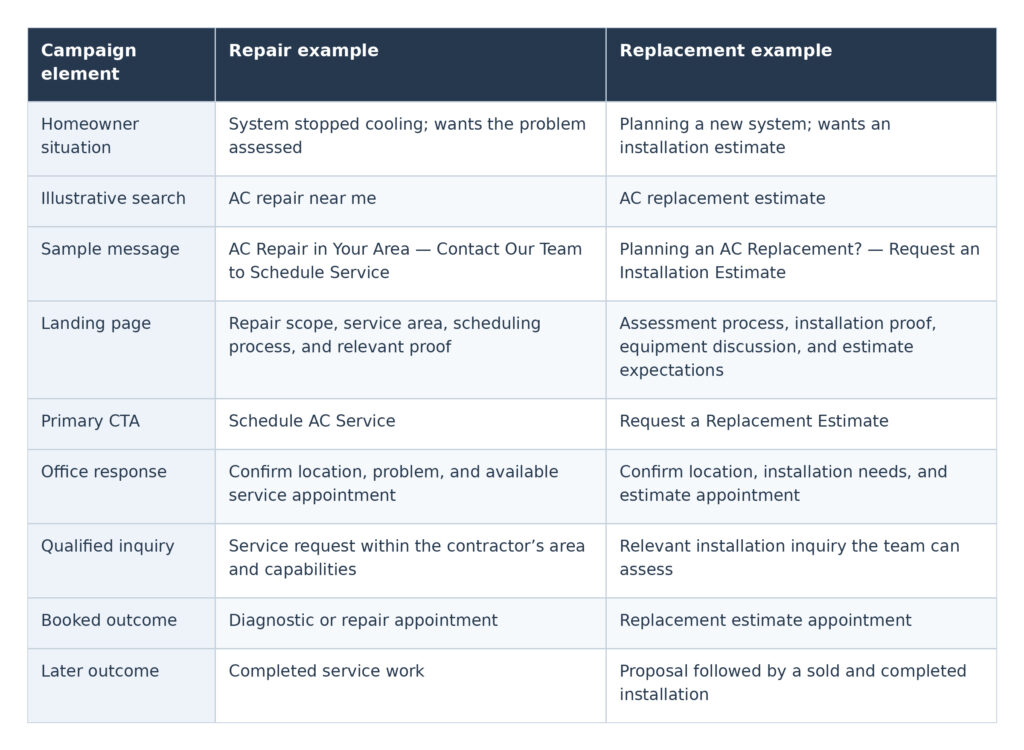
Consider a fictional contractor that offers repair and installation within one service area. These examples are illustrative campaign plans, not BrandNation client results. Search phrases and ad messages are examples rather than verified keyword recommendations or complete Google Ads builds.
A Repair Inquiry From Search to Appointment
The homeowner clicks the repair ad and lands on the AC repair page. The page confirms the service territory, explains the scheduling process, and provides a visible phone number and service request option.
The office asks where the system is located, what problem the homeowner is experiencing, and when an appointment can be arranged. It records the source and requested service before booking. The technician’s assessment then determines the appropriate work.
The useful first outcome is the booked service appointment. Later, record whether the appointment happened and what work was completed. A click on the phone number alone does not confirm that conversation or booking.
A Replacement Inquiry From Search to Estimate
The homeowner clicks the replacement ad and reaches a page describing the installation assessment. They see relevant project proof and understand what to expect from an estimate request.
The office confirms the property’s location and the homeowner’s needs, then schedules the estimate appointment. The sales process records whether the visit took place, whether a proposal was delivered, and whether the installation was sold.
If the homeowner is still comparing options, follow up according to the company’s agreed process. An estimate request is a meaningful opportunity, but it is not a sold installation. Reporting should preserve that distinction.
Match the Landing Page to the Requested Next Step
Repair Pages Should Make Service Details Easy to Find
Check the page on a phone. Can the visitor confirm you handle the problem and serve their area? Can they find the contact option without searching? Do the page and ad describe the same next step?
Keep service details, verified availability, and scheduling expectations near the inquiry options. Use proof relevant to repair work. If a diagnostic fee applies, explain it accurately where appropriate so the office is not correcting a misleading impression.
Replacement Pages Should Help Buyers Evaluate the Estimate
Explain how the team evaluates the home and develops installation options. Show approved project examples and verified warranty or financing information when relevant. Help the homeowner understand what they are requesting and what happens after submission.
A single website can support both journeys. The important point is to give each ad a relevant destination and next step. If the site makes that difficult, review the structure of its service-specific landing pages.
Give Undecided Homeowners a Suitable Route
For visitors weighing repair against replacement, offer an assessment or conversation rather than forcing a decision. Explain how the business evaluates options without claiming that every old system should be replaced.
The office needs to see which route the visitor used. Otherwise, a carefully written landing page can still lead to the wrong conversation. Coordinated HVAC marketing connects the message, website, and response process.
Separate Campaigns When You Need Separate Control
Use Business Priorities to Guide the Structure
In HVAC Google Ads planning, separate campaigns can be useful when repair and replacement need different budget limits, locations, scheduling, or business priorities. For example, a contractor may have installation capacity available while its repair schedule is full.
Write down the reason for separation before restructuring. The goal is to control something meaningful and report outcomes clearly. BrandNation’s HVAC PPC management page explains the broader management scope; this comparison helps you evaluate one specific campaign decision.
Avoid Splitting a Small Account Into Too Many Pieces
If inquiry volume is limited, many small campaigns can make performance harder to evaluate. Start with enough structure to match messages and destinations, then expand when a specific operational or reporting need justifies it.
Do not choose a repair-versus-replacement budget split from a generic rule. Review demand, service economics, available capacity, and reliable outcomes. A higher-value installation does not automatically make every replacement inquiry a better investment.
Review Actual Searches Before Adding Exclusions
Review the searches triggering your ads and compare them with the offer. Google’s search terms report documentation explains how this information can help identify irrelevant searches.
Use exclusions carefully. A phrase that is irrelevant to one campaign may matter to another. Blocking repair-related language everywhere could remove homeowners who are genuinely evaluating their options. Check the intended scope and match type using Google’s negative keyword guidance.
Paid search is also one part of the wider HVAC advertising strategy. Keep this review focused on the repair and estimate journeys rather than trying to change every advertising channel at once.
Measure Repair Bookings and Replacement Estimates Separately
Define Each Outcome Before Comparing Costs
Agree with the office and sales team on what each stage means. Track raw inquiries, qualified inquiries, booked appointments, and completed or sold work as distinct outcomes. Use consistent definitions within each service line.
The following figures are hypothetical and illustrate reporting only. They are not industry benchmarks. Assume both groups have been observed long enough for appointments and sales outcomes to be recorded. Costs below include ad spend only.
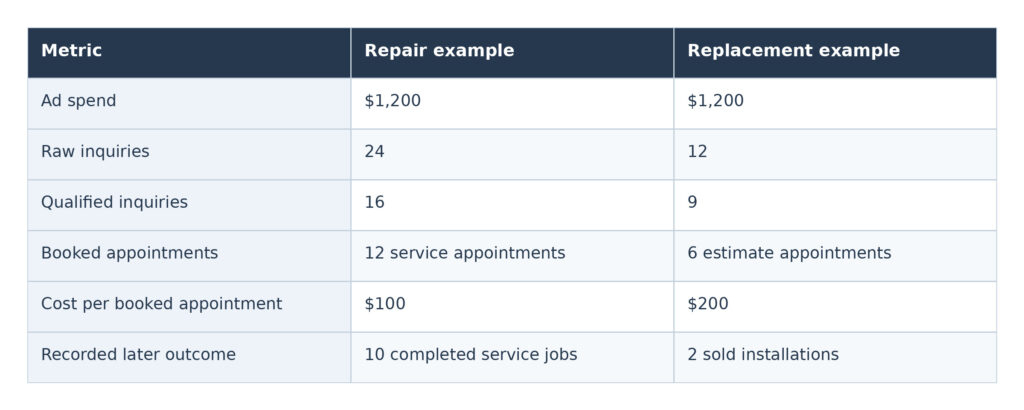
Cost per booked appointment equals ad spend divided by booked appointments in this example. The replacement appointment costs more, but the table alone cannot tell you which campaign is more profitable. You still need actual revenue, gross profit, delivery costs, and an appropriate attribution window.
Compare Outcomes Over an Appropriate Timeframe
A repair appointment and an installation sale may progress at different speeds. Avoid comparing fully recorded repair outcomes with replacement leads that are still awaiting estimates or decisions. State which period and lead group the report covers.
Include management, creative, software, or other costs when reporting total acquisition cost, and label the basis clearly. Do not present an ad-spend-only figure as the full cost of winning a customer.
Connect Campaign Reports With Sales Outcomes
Where your tracking supports it, connect campaign inquiries with qualified leads and subsequent outcomes in the CRM or field-service system. Google provides offline conversion guidance for measuring stages beyond the initial online action.
Choose the outcome your business can record reliably. Check that stages are not accidentally combined or counted twice in a headline lead total. Better tracking should clarify the work generated, not merely increase the number of reported conversions.
Use This Campaign Review Checklist
- Identify whether each priority ad asks for repair service, a replacement estimate, or an assessment.
- Check that the ad and landing page promise the same next step.
- Verify service areas, availability, and offer terms.
- Test phone and form routes on mobile and desktop.
- Confirm that the office can identify the requested service.
- Define qualified inquiries and appointments for each journey.
- Review search terms and the scope of exclusions.
- Compare bookings and later outcomes over suitable reporting windows.
- Match spending decisions to dispatch and estimate capacity.
Start with the first mismatch you can demonstrate. If a replacement ad sends visitors to a generic repair page, improve the destination. If calls reach the office but estimates are not recorded, fix the reporting process before drawing conclusions about campaign quality.
Are Your Ads Generating the Jobs You Want to Book?
Review one repair campaign and one replacement campaign from search through sales follow-up. If you need help identifying where the message, page, or measurement breaks down..
Frequently Asked Questions
Should repair and replacement ads use separate campaigns?
Separate campaigns can help when budgets, service areas, schedules, or business priorities differ. The decision should also account for inquiry volume and how much data is available. Separation is useful when it provides control you actually need.
Can repair and replacement ads share a landing page?
They can, but the page must make the relevant information and next step clear for each visitor. Dedicated pages are often easier to align with a specific message. Avoid sending both groups to a generic destination that answers neither need well.
How should you advertise to homeowners who are unsure whether to repair or replace?
Offer an assessment or service conversation. Explain the evaluation process and let the findings guide the recommendation. A problem-based search does not establish that replacement is necessary.
Should repair keywords be excluded from replacement campaigns?
Review the actual searches and campaign purpose first. Some repair-related searches may indicate comparison or replacement consideration. Apply exclusions at the appropriate scope rather than using a blanket rule.
What counts as a replacement lead?
Define it with your sales team. A relevant installation inquiry may be qualified, but an estimate appointment, delivered proposal, and sold installation are later stages. Report them separately.
Is cost per lead enough to judge an HVAC campaign?
No. Review qualification, bookings, completed work, and sales outcomes where available. Label the costs included and allow enough time for the lead group to progress.
How should advertising change when the schedule is full?
Review the work your team can still accept and adjust spending, scheduling, and messages accordingly. Keep availability claims accurate. Do not keep buying inquiries without a realistic response and fulfillment plan.