For Google Ads, choose the page that best matches what the person searched for, what your ad promises and what they need to do next. A homepage can work when it answers those needs. A relevant service page may already do the job. A dedicated landing page becomes useful when your campaign needs a more focused offer or information your existing pages do not provide.
The landing page vs homepage decision starts with the visitor. Before building another page, check whether your current destination makes the advertised service easy to understand and the next step easy to take.
Landing Page vs Homepage: What Is the Difference?
In Google Ads, a landing page is the page someone reaches after clicking an ad. That can be your homepage, a service page or a page built specifically for the campaign. Google’s landing-page definition makes this distinction clear.
Here, “dedicated landing page” means a page organized around a particular campaign or offer. It has a narrower purpose than a homepage, but it still needs enough information to help visitors judge the business and the service.
What a Homepage Helps Visitors Do
A homepage helps people understand who you are, what you offer and where to go next. It can be a good destination for someone exploring your business or selecting among services. The important question is whether the information they came for is easy to find.
What a Dedicated Landing Page Helps Visitors Do
A dedicated page gives you room to explain a specific offer, show relevant proof and guide one main action. It can be useful when your homepage would make the visitor work through unrelated information. Focus should make the page easier to use, without hiding information buyers need.
When Does a Homepage Make Sense for Google Ads?
Consider your homepage when the search and ad are about the business as a whole, or when a focused business has a homepage that closely matches the advertised offer. A person searching for your company by name may need contact details, credibility and a clear route to the right service.
Review the page from that visitor’s perspective. Can they identify the business, confirm the relevant service and take the intended next step without hunting through the site? If yes, the homepage deserves consideration. If the ad promotes a narrow offer buried beneath several services, evaluate a more specific destination.
When Should You Use a Dedicated Google Ads Landing Page?
Consider a dedicated Google Ads landing page when you need to explain a particular offer, address a distinct buyer need or provide campaign-specific details missing from your current site. It also gives you a defined destination to review when the current page’s message does not match the ad.
Build around the information gap. A new URL with the same broad content as your homepage does little to help the visitor make a decision.
When an Existing Service Page Is Enough
A strong service page may already explain the offer, service area, process, relevant proof and contact options. If it matches the ad and works well on mobile, test it before commissioning a separate page. If the page needs a clearer structure or missing information, that may be a useful improvement to your existing website.
BrandNation’s custom website design service connects page planning with the wider site experience, so campaign visitors can reach information they need.
Match the Search, the Ad and the Page
Imagine a fictional HVAC company advertising AC repair. A visitor searching for repair help expects the destination to explain that service. A general introduction to heating, cooling and maintenance may require extra steps before the visitor finds an answer.
Use the ad’s promise as a check. If it names an offer, the page should explain that offer and any conditions. If it names a service area, visitors should be able to confirm it. Avoid implying availability or guarantees that the business has not approved.
This alignment is part of Google Ads campaign management: choosing the destination matters alongside targeting, messaging and measurement.
What Should a Google Ads Landing Page Include?
Before sending paid traffic to any destination, check these essentials:
- A clear offer: the opening heading and explanation match the advertised service.
- Useful details: scope, service area, eligibility or conditions help visitors judge fit.
- Relevant proof: approved examples, reviews or credentials support the claims made.
- A clear next step: the form or contact option tells visitors what happens afterward.
- Helpful navigation: people can find business information, support and relevant details.
- Mobile usability: text, buttons and forms remain readable and usable on a phone.
- Working measurement: completed actions are recorded consistently, with appropriate consent handling.
Do not remove every link simply because the page supports a campaign. Google’s guidance on landing-page navigation emphasizes helping people reach the information they expected. Keep useful routes while making the primary action clear.
Compare Two Page Options Before You Build
The mockups below show the same fictional HVAC business. The homepage offers broad service choices. The repair campaign page puts repair information and its contact action closer to the visitor’s immediate need.
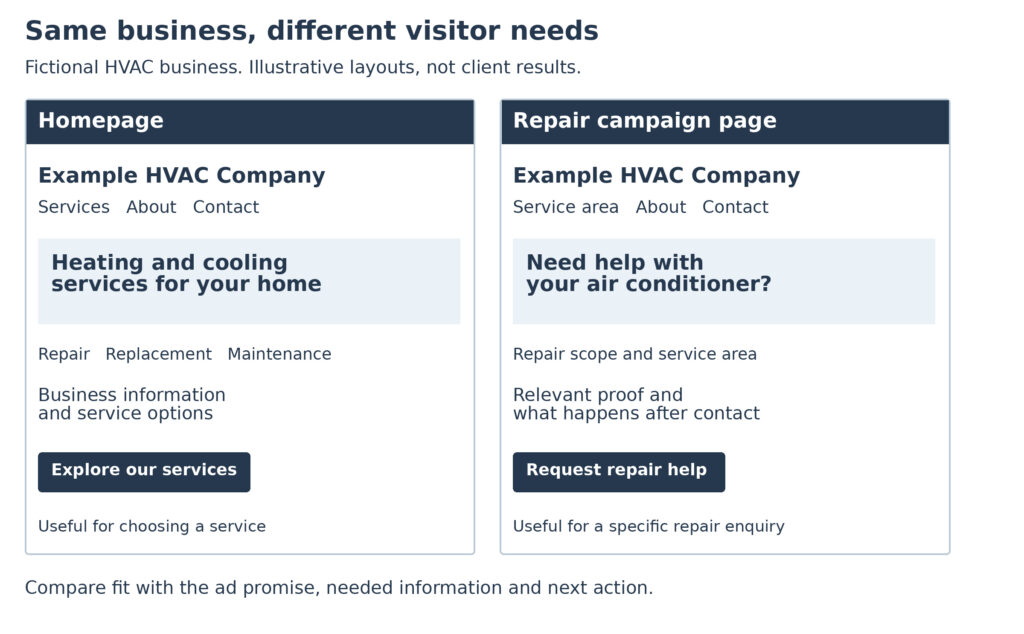
Illustrative layouts for a fictional business. These are not client screenshots or measured performance results.
On the homepage, a visitor can explore repair, replacement and maintenance. On the campaign page, they can review repair scope, service area and relevant proof before requesting help. Neither layout is automatically the winner: the right choice depends on the ad, the visitor and the information provided.
How to Measure Which Destination Works Better
First verify the enquiry path: the ad opens the intended page, the form submits successfully and the completed submission is recorded. A form start or button click does not confirm a lead. A phone-button click does not confirm a completed conversation.
Google’s conversion measurement guidance describes connecting ad interactions with customer actions. Choose actions that reflect your business goal and check that the same action is not counted twice.
Compare destinations under similar campaign conditions. If the targeting, ad offer, budget and page all change together, it becomes harder to identify what caused the result. Review relevant visits, completed enquiries and lead quality. Use sales feedback to distinguish suitable prospects from unrelated contacts.
A short test with only a few enquiries may not settle the question. Set the outcome you want to measure, allow enough traffic and account for seasonality and campaign changes before deciding.
Choose Your Campaign Destination
Use this decision worksheet before approving new page work:
| Question | Your answer |
|---|---|
| What search need and ad promise must the page answer? | |
| Which existing page answers that need best? | |
| What information or proof is missing? | |
| Can the visitor take the intended action on mobile? | |
| Will a dedicated page add useful content or a clearer path? | |
| How will completed enquiries and lead quality be measured? |
If an existing page meets the need, start there. If it needs specific improvements, define them. If the campaign requires a distinct offer and a clearer path, plan a dedicated page around those requirements.
BrandNation can help connect your website destination with your advertising campaign. Start with the offer, the buyer’s questions and the action your business wants to receive.
Can I Use My Homepage as a Google Ads Landing Page?
Yes. A homepage can be the destination for an ad. Use it when it closely matches the search and ad promise, provides the needed information and makes the next action easy. Compare it with a relevant service page before deciding.
Do I Need a Separate Landing Page for Every Campaign?
No. Different campaigns can use the same destination when it answers their visitors’ needs. A separate page is useful when the offer, information or intended action needs to be different. Avoid creating near-identical pages without a clear purpose.
Should a Landing Page Have Navigation?
Include navigation that helps visitors find relevant information. A focused campaign page can still link to business details, service information and support. Make the primary action clear without preventing buyers from checking what they need.
Does a Dedicated Landing Page Guarantee More Enquiries?
No. Results also depend on the offer, targeting, ad message, demand and follow-up. A dedicated page can improve the fit between an ad and its destination, but its effectiveness must be measured using meaningful outcomes.