Before an industrial buyer requests a quote, they need to know whether your company can handle the job. Your website should explain relevant capabilities, provide useful technical information, show credible proof, and make the next step clear. An RFQ form then needs to collect enough detail to start a productive sales conversation.
A website can attract the right visitor and still leave that person with unanswered questions. Can you work with their material? Is their project within your capabilities? Can they send a drawing? Who should they contact if the specifications are still taking shape?
Industrial website design needs to account for those questions. This checklist helps you review what buyers see before they ask for a price, and what your sales team receives afterward. RFQ means request for quote.
Can a Buyer Tell Whether Your Company Fits the Job?
Start with a capability page your sales team regularly shares. Ask someone unfamiliar with your company to explain which jobs you can take on after reading it. If the answer is vague, the page needs clearer information.
Make Capabilities and Applications Specific
“Precision manufacturing solutions” gives a buyer little to evaluate. Name the processes you offer, the materials you handle, and the applications you support. Connect each capability to a useful explanation rather than placing every detail in a single company overview.
For a machine shop, that might mean separate information about milling and turning, supported materials, and typical part applications. For an equipment supplier, it might mean operating conditions, compatible systems, and installation requirements. Include only capabilities the business can substantiate.
State Practical Limits and Purchasing Requirements
Give buyers enough information to recognize a suitable project. Relevant details may include part dimensions, order quantities, geographic coverage, or whether you handle prototypes and production runs. Requirements will differ by business.
Avoid publishing a fixed lead time if it changes with capacity or material availability. Explain what affects scheduling and how buyers can confirm current availability. Accurate boundaries can save both the buyer and your sales team an unnecessary exchange.
Put Technical Information Where Buyers Need It
Technical information should be easy to find from the page that creates the question. A buyer reviewing a product should not have to search an unrelated downloads page to locate its data sheet.
Connect Specifications to the Right Capability or Product
Where relevant, provide dimensions, material options, tolerances, operating ranges, compatibility information, and current documentation. Label each resource clearly so buyers understand what it contains before downloading it.
Manufacturing website design should also make those resources usable on a phone. Check whether tables are readable, PDFs open correctly, and the route back to the inquiry page is obvious. Keep revision dates or document identifiers visible when they matter.
Separate Public Information From Details That Need a Conversation
You do not need to publish every drawing, price, or customer requirement. Explain which information is available publicly and how a buyer can request project-specific guidance. When confidentiality matters, describe the approved process for discussing the job before asking for sensitive files.
Show Proof That Helps Buyers Evaluate Supplier Risk
A buyer needs evidence that relates to the work they are considering. A photo of a facility can provide context, but a project example that explains the requirement and work performed is more useful for evaluating fit.
Explain Certifications and Quality Processes
List verified credentials with their applicable scope. If a certification covers a particular location or operation, make that clear. Review the information when credentials change.
Explain relevant inspection, testing, traceability, or quality processes in plain language. ISO’s quality management overview provides background on quality systems, but any claim about your own certification needs supporting documentation. A credential is not a substitute for explaining how you meet the buyer’s requirements.
Use Project Examples With Useful Context
A useful example identifies the application, the requirement, the work performed, and the documented outcome. Add approved photos or technical detail where they help explain the job. If customer confidentiality limits disclosure, use an approved anonymized example and state that context.
Keep the evidence specific. Do not add a percentage improvement or customer result unless you have records supporting it and permission to publish it.
Build an RFQ Form That Starts a Useful Sales Conversation
The form should collect what your team needs to assess and route the request. Ask sales which missing details cause the most follow-up, then decide which belong in the first inquiry and which can wait.
Ask for the Information Needed to Assess the Request
A starting point may include the buyer’s name, company, email, requested capability, and a short project description. Quantity and timing may be important for some businesses. File uploads can help when drawings or specifications are needed, but they should not block buyers who have no file to share.
Mark required and optional fields clearly. Use visible labels and helpful instructions. Nielsen Norman Group’s form usability recommendations offer practical guidance on form structure; its required-field guidance explains how to make field expectations clear.
Offer a Route for Buyers Who Are Not Ready for an RFQ
Some buyers have a defined part and quantity. Others are still deciding which process, product, or specification fits their application. Give the second group a suitable option, such as “Discuss Your Application,” alongside “Request a Quote.”
Make the purpose of each route clear. An application discussion should reach a person who can help evaluate the requirement, rather than sending the buyer back to the same form with the same unanswered questions.
Explain What Happens After Submission
Tell buyers what the next step will be. Your confirmation can explain that the team will review the information and contact them about missing details or quote preparation. State a response timeframe only when the team can reliably meet it.
Test the complete process. Submit an inquiry on mobile and desktop, check the confirmation, and verify that the right team receives it. A working button is only one part of a working inquiry path.
Follow the Buyer’s Path From Capability Page to Quote Request
The following fictional machine shop example shows how a capability page can answer questions in a useful order. It illustrates a layout, not a BrandNation client project or a promise of results.
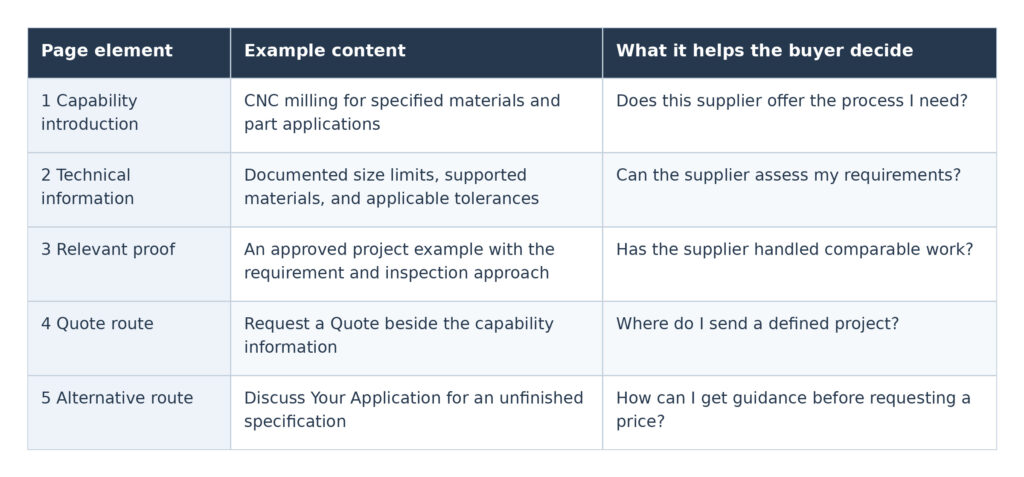
In a practical page layout, keep the inquiry options close to the information they relate to. A buyer should be able to move from evaluating the capability to contacting the right team without searching the menu.
If several pages need this treatment, review the structure with the people who answer inquiries. BrandNation’s website design and marketing services for industrial companies connect the website with the wider buying process.
Use This Industrial Website RFQ Checklist
Review one important capability or product page first. Mark each item complete only when you can point to working, current evidence. Use the final column to record the next action.
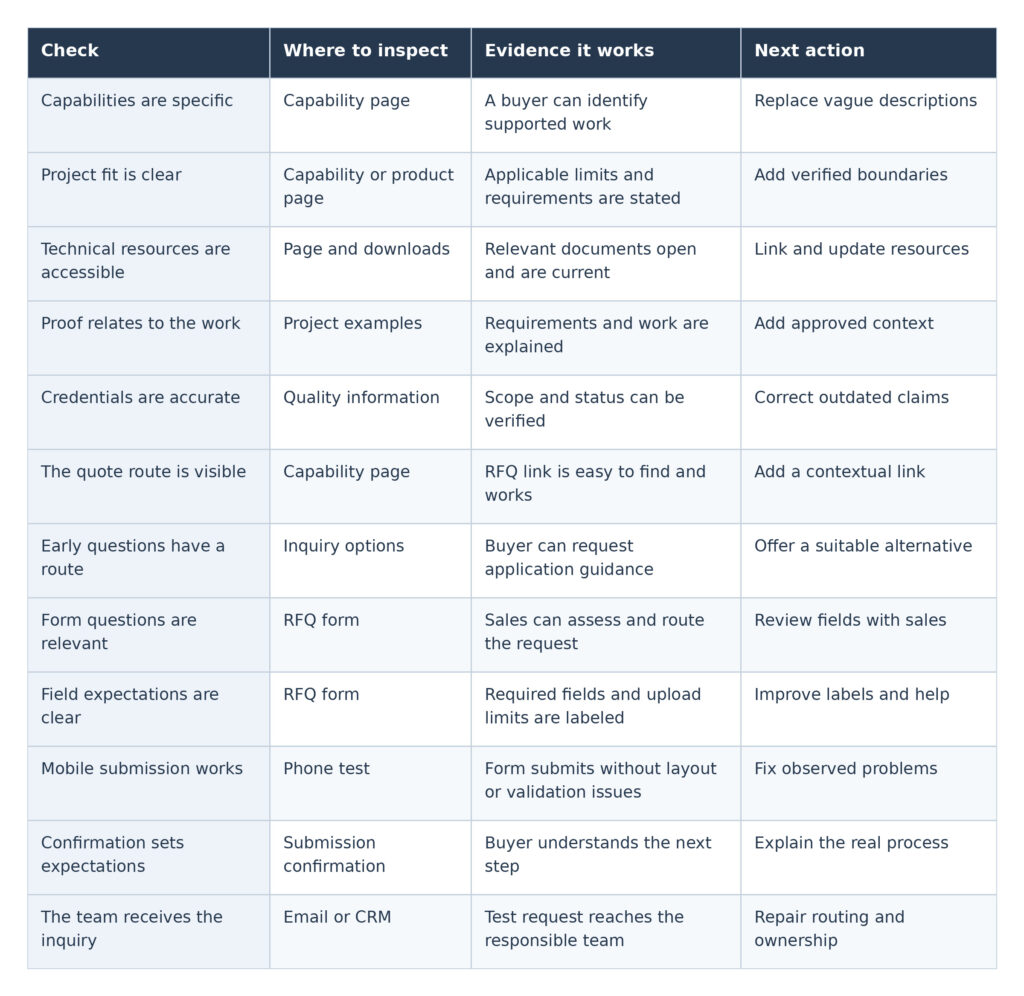
For example, if a capability page has current specifications but no visible quote link, the first task is to add and test that link. If requests arrive without quantities, ask sales whether quantity should be required initially or collected during follow-up. The checklist should produce specific changes, not a general instruction to “improve the website.”
Fix the Gaps That Matter Most
Start With Missing Information and Broken Inquiry Paths
Fix submission failures and routing problems first. Next, address missing information that prevents buyers from establishing fit. Then improve proof, document access, and the connection between relevant pages and inquiry options.
A complete rebuild may not be necessary. A useful capability section, clearer inquiry options, or better form instructions may address the immediate problem. Consider a broader custom website design project when navigation, page structure, or the platform repeatedly prevents useful improvements.
The RFQ journey is one part of an industrial marketing strategy. Use the wider strategy to determine which capabilities, applications, and buyer groups deserve priority; use this checklist to improve their route to an inquiry.
Measure Inquiry Quality Alongside Form Completion
Track completed RFQs separately from form starts and button clicks. Then review the inquiries with sales. How many match your capabilities? How many contain enough information for the next step? How many progress to quote preparation?
Agree on what counts as a qualified inquiry before reporting improvement. Record missing details and rejected requests so you can see whether the website needs clearer boundaries or different questions. Review results over a period appropriate to your inquiry volume and sales cycle.
Ready to Review Your Website’s Quote Process?
Use the checklist with your marketing and sales teams to identify the first page or inquiry step that needs attention. If you need help turning those findings into a practical website plan contact us.
Frequently Asked Questions
What should an industrial website include before asking buyers to request a quote?
Show relevant capabilities, practical requirements, technical information, and credible evidence. Make the quote route easy to find and explain what happens after submission. The level of detail should reflect the products or services you sell.
What information should a manufacturing RFQ form collect?
Collect the contact and project information your team needs to assess and route the request. Depending on the work, that may include capability, material, quantity, timing, and a drawing. Require fields only when they are needed for the first review.
Should buyers be able to upload drawings?
Offer uploads when drawings help your team evaluate a request. Explain accepted formats and file limits, provide a route for confidential information, and let buyers ask questions when they have no drawing.
Do industrial websites need to publish pricing?
Not always. Custom work may require specifications and a project review before pricing is possible. Explain what the quote depends on and what buyers should provide. Publish prices only when they are accurate and appropriate to the offer.
What if a buyer does not have complete specifications?
Offer an application discussion or technical inquiry route. Ask for enough context to connect the buyer with the appropriate person, then help clarify what is needed before a quote can be prepared.
How do you measure whether website inquiries are qualified?
Define qualification with sales, then review completed inquiries against those criteria. Useful indicators include capability fit, sufficient project detail, acceptance by sales, and progression to quote preparation. A form submission alone does not establish qualification.